
Research Agenda in Science Integration: Kudus State Institute of Islamic Studies
Khazanah
There are four disciplines about the Agenda in National Religious Research or Agenda Riset Keagamaan Nasional (ARKAN) 2018-2028. Islamic studies, pluralism and diversity, science integration and global development. For these disciplines, I would like to give the critics in many ways. There is a lack of studies or research on public policies that can be used as a standard for qualifying the Ministry of Religion\'s services. There is a lack of studies or research on the guarantee of halal products, which is very important in the future. There is a lack of studies or research on communication and the spread of Islam in the context of modern society. There is a lack of studies on local wisdom that is the basis for the development of local Islamic traditions. There is a lack of studies and research on literature and other arts. There is a lack of studies and research on the dimensions of language and tradition and their development in the modern era.
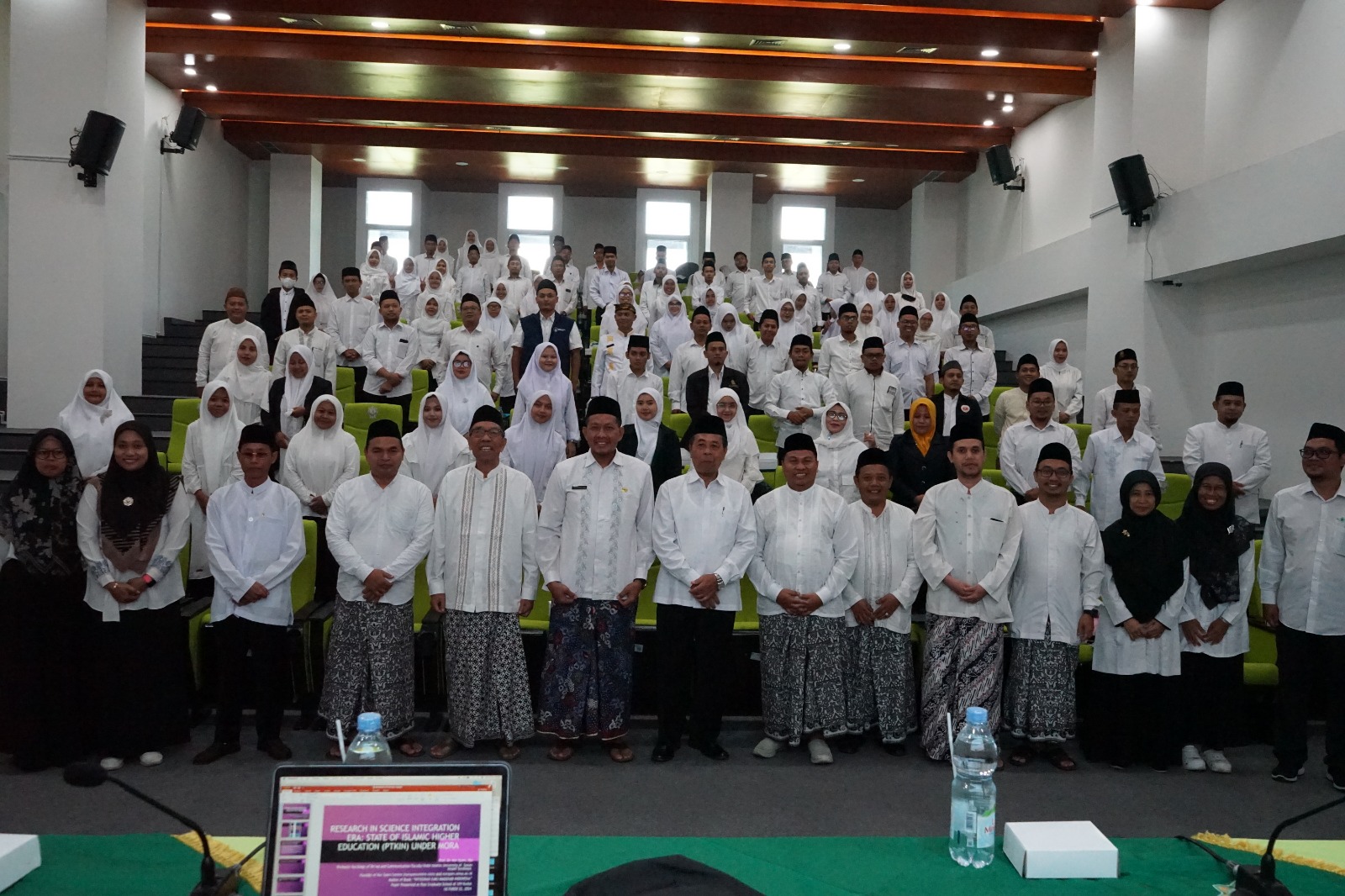
This is my starting point as the opening statement of stadium general held by IAIN Kudus. Prof. Dr. Abdurahman Kasdi, Rector of IAIN Kudus was formally opening this Stadium General, October 22, 2024. There are many lectures attend this meeting, Director of Post Graduate School, Prof. Dr. M. Nur Gufron, Prof. Dr. Mudzakir, and the student of Magister and Doctorate Program.
As a State of Islamic Higher Education (PTKIN) under the Ministry of Religious, one of its authorities is to organize religious studies and programs. Additionally, PTKIN has been given the mandate to manage general study programs, as stated in the Presidential Decree on institutional transformation from State Islamic Institute (IAIN) to State Islamic University (UIN). After transforming into UIN, PTKIN can manage both religious and general education. UIN is a general education institution based on religion, similar to how a madrasah is a general education institution based on religion. There are two types of UIN: those that fully organize general education and those that partially organize general education.
PTKIN has emerged as a leader in the development of science-based approaches, moving beyond traditional study subject-based methods. The concept that has been developed is a science integration program, employing interdisciplinary, cross-disciplinary, multidisciplinary, and transdisciplinary approaches. According to the Indonesian National Qualification Framework (KKNI), there are two interdisciplinary and multidisciplinary approaches. However, Prof. Amin Abdullah suggests there are three approaches: interdisciplinary, multidisciplinary, and transdisciplinary. Meanwhile, Prof. Nur Syam proposes four approaches: interdisciplinary, cross-disciplinary, multidisciplinary, and transdisciplinary.
In the ARKAN 2018-2028, it is found that globally the Research Agenda of the Ministry of Religious Affairs are Islamic Studies, Pluralism and Diversity, Scientific Integration and Global Development. It is imagined that the integration of science is a field or discipline that is different from other fields or disciplines. Islamic Studies, Pluralism and Diversity, and Global Development are separate from the integration of sciences.
The integration of science should be the basis for all research development at the Ministry of Religion. Islamic studies must use an integrative approach. Pluralism and diversity also use an integrative approach, global development also uses an integrative approach.
The integration of science is the spirit for the development of science at PTKIN to distinguish it from the development of science at PTU.Based on Law No. 12 of 2012, there are six clusters of sciences, namely religious sciences, humanities, social sciences, science and technology, applied sciences and formal sciences.
This convergence of science is a new paradigm in the world of science in the world.The group of science is characteristic of Indonesia. A unique and distinctive group of science.In the international world, including UNESCO, only three groups of sciences are known, namely natural sciences, social sciences and humanities. The view of positivists, that what cannot be observed and cannot be verified or even falsified is not science.
Baca Juga : Melabuhkan Sampah di Momentum SDGs Desa
In this paradigm, religion cannot be categorized as a science, because it is based on belief.This belief departs from the occult so that it cannot be observed, verified and falsified. Religion cannot be used as a science because it does not meet scientific standards.
A new paradigm is needed to see religion as a science. There are sensual empirical, logical empirical, ethical and transcendental empirical based truths. Through transcendental empirical truth, religion has a great home to become science.The integration of science is the merger of two or more branches of science, one being the subject of matter and the other as an approach. Religious studies are the subject of study or subject matter, while other sciences are an approach. The approach can be in the form of theoretical concepts in the disciplines of social sciences, humanities, science and technology. For example, sociological theory, communication theory, anthropological theory, political theory, psychological theory, legal theory or theories in the social sciences.
For example, in the discipline of cultural sciences, for example philosophy, history, literature, language, art, and others. For example, in the disciplines of science and technology, such as architectural theory, physics, chemistry, biology, geology, and others.
Interdisciplinary paradigm, which is the merger of two branches of science in one discipline, for example between religious sciences, between social sciences, between humanities or between science and technology. For example, da\'wah interpretation, da\'wah hadith, tarbiyah fiqh, legal sociology, political communication, social psychology, literary philosophy and so on. The cross-disciplinary paradigm, which is the merger of two branches of science in two different disciplines, for example between religious science and social science, between social science and humanities or between religious science and science and technology. For example, sociology of religion, psychology of religion, anthropology of religion, Islamic architecture, history of religion, philosophy of law and others.
Multi-disciplinary paradigm, which is the merger between two or more branches of science in the same or different disciplines. For example, between religious science and social sciences and humanities or between religious science and science and technology. For example, the branch of sociology that is approached with the branch of anthropology and communication or the branch of religious science that is approached with the branch of humanities and the branch of sociology.
The transdisciplinary paradigm is the merger between two or more branches of science in one discipline or different disciplines. If in multidisciplinary the conclusion is based on each approach, while in transdisciplinary the conclusion is in one unit.For example, the study of the branch of sociology is approached with psychology, culture, religion and economics. So the conclusion will be a unit.
There is a statement: \"the only permanent aspect of science is research.\" Science will not develop without research. That is the process of serious assessment of the subject or object of scientific study through reasoning or deep thinking that results in the study of thought or philosophy, and an in-depth study that is carried out on the object of study or subject matter through field research. We can choose which one is in accordance with our themes, problems, and passions in the study of Islamic studies.
Baca Juga : Nabi Muhammad SAW Sebagai Insan Kamil Mutlak
A good thesis or dissertation is a completed thesis or dissertation. A simple title can be great if done very adequately. The greatness of a dissertation is not because of the title but because of the discussion.
The study of the Holy Texts (the Qur\'an and the hadith of the Prophet Muhammad (SAW) includes the science of the Qur\'an, the science of interpretation, the science of Hadith, and the science that can be attributed to the two sacred texts. The study of Non-Sacred Texts includes the study of the thoughts of mufassir or ahl hadith in understanding or interpreting sacred texts. For example, about Creed, Sharia and Morals.
It can be in the form of descriptions, comparisons, historical, criticism and others related to the study of texts. Empirical study, which is the study of sacred texts that live in individuals, communities or societies. Studying people\'s understanding of texts and the implementation of these texts in life.
It can use a variety of approaches, for example: Sociological, which is the study of texts or teachings in society, and how society uses these texts as the basis for interrelation and interaction between them. For example, the study of the meaning of Jihad in the perspective of Kiai NU in Kediri.
Anthropological, which is to examine religious texts/teachings that are used as a pattern for community actions in a certain area. Religious teachings are guidelines for behavior that have been traditional in oneself and the community or society. For example, Islamic teachings as a substance in the nyadran ritual in agricultural communities. Psychological, which is the study of religious texts/teachings in the lives of individuals that produce religious experiences. For example, the Religious Experience of the mursyids of the Qadiriyah wa Naqsyabandiyah order in East Java.
Communication, which is a teaching that is used as a basis for conducting relationships or communication in both traditional and modern media. For example, the communication pattern of ulama and umara in the socialization of Sharia banking.
Law, how texts about Islamic law can be compared with positive law in Indonesia, for example a comparison between texts on marriage between fiqh law and positive law in Indonesia. Science and technology, namely dialogue or integration between Islamic texts/teachings with the empirical reality of science and technology, for example the creation of human beings in the text of the Qur\'an.
The research themes in Islamic studies cover a wide range of topics. These include the intersection of fiqh with sociology, such as social fiqh, labor fiqh, and gender fiqh. Additionally, there are research themes that explore the connection between psychology and religious science, including Islamic psychology, therapy, counseling, and hypnotherapy.
Communication research in Islamic studies delves into areas like da\'wah communication, social media ethics, and the commodification of educational content. Anthropological research within Islamic studies covers inheritance and log ritual traditions. Furthermore, there are themes focusing on law and Islamic science, such as Islamic family law, constitutional fiqh, criminal fiqh, and Islamic economic law. Lastly, the study of Islamic science with the Qur\'an or al-hadith includes topics like the living Qur\'an, the living hadith, and the living Sufism.
The theme of Qur\'anic studies with linguistic approaches, for example, sociolinguistics, semiotics, and hermeneutics. Research on the Meaning of Islamic Verses rahmatan lil alamin in a hermeneutical perspective on dai in Central Java. The theme of hadith studies with a linguistic approach, for example, sociolinguistics, semiotics, and hermeneutics. Semiotic Study of Jihad Hadith. The theme of non-sacred textual studies is through sociolinguistic, semiotic, and hermeneutical approaches. For example, research on the meaning of Jihad in the Book of Majmu\' Fatwa by Ibn Taymiyah in a Hermeneutic Perspective. Research on Islamic Politics in the Book of Al Ahkam Al Sulthaniyah Al Mawardi from the perspective of hermeneutics.
Master\'s and doctoral programs should focus on conducting studies on Islamic scientific issues using various approaches, including interdisciplinary, cross-disciplinary, multidisciplinary, and transdisciplinary methods. It is important to revise the curriculum to align with the direction of national religious research (ARKAN) and to take critical notes on the ARKAN into consideration. Consider implementing team teaching to support the development of science programs based on the integration of various scientific disciplines.
Being a doctor, one must have a deep understanding of research methodology. Being a doctor signifies expertise in a particular field of science, along with strong research and writing skills. In Indonesia, earning a doctorate is associated with being a research expert. Unlike in some other countries, where this may not be the case. Therefore, it\'s essential for doctors to be well-versed in research methodology. To achieve this, one must thoroughly understand the relevant clusters, concepts, and theories in their field of study.
Wallahu a’lam Biasshawab