
The Ethical Dimensions of Artificial Intelligence in Education, Society, and Religion
Opini
First of all, I want to say thanks for all of the audiences. Especially, honorable Prof. Ahmad Zainul Hamdi, the rector of UIN Sultan Thaha Saifuddin (STS) Jambi. The popular name is Cak Inung or Gus Inung, formally He is a Director of Islamic Higher Education, Ministry of Religious Affairs. The honorable Prof. Dr. Risnita, the Director of Post Graduate School of UIN STS Jambi. The Vice Rector, Vice director, The dean dan vice dean, the lecturers and all of audiences.
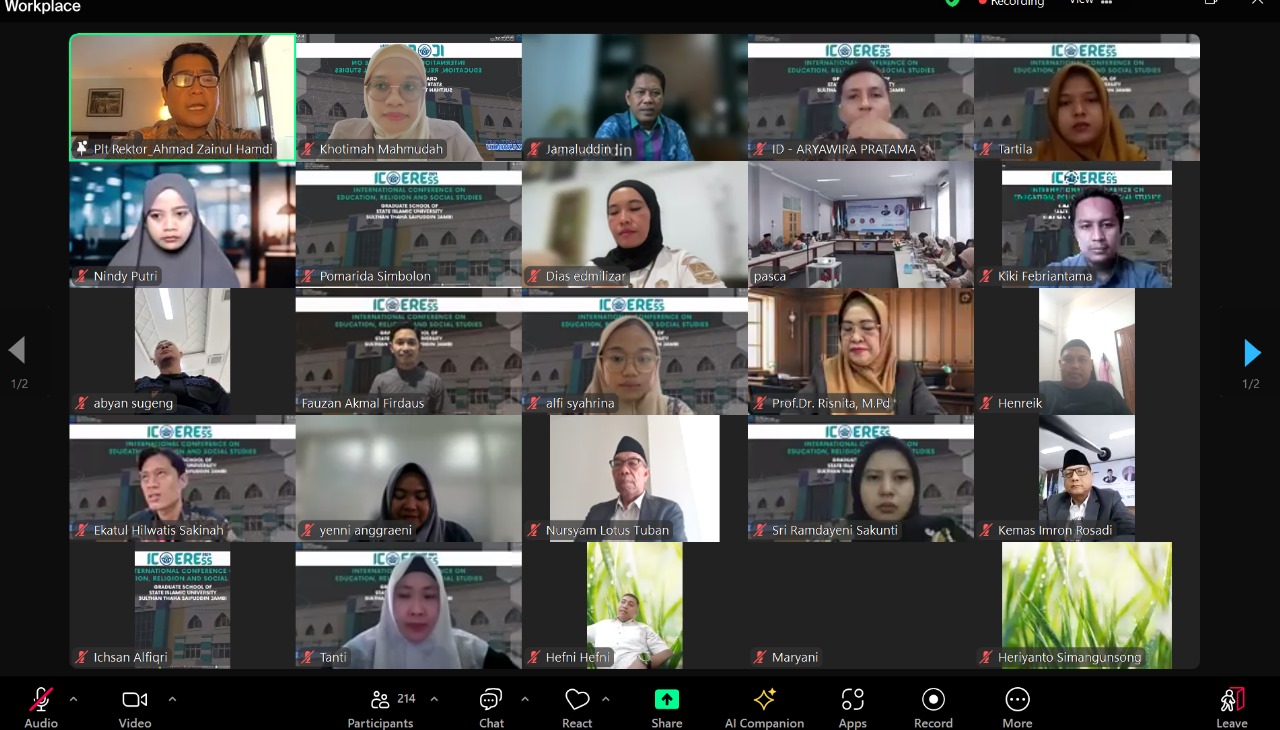
Especially to distinguish speaker of this conference, Prof. Dr. Michele Notari, from the University of Teacher Education Bern Switzerland and Prof. Dr. Raja Nor Safinas Binti Raja Harun from the University of Sultan Idris Education, Malaysia. Welcome to Indonesia, welcome to Jambi, insyaallah happy in UIN STS Jambi. This is my opening presentation in the International Conference was held by Post Graduate School of UIN STS Jambi, October 16, 2024 by Zoom. There are three points for may paper.
First, artificial intelligence and social change. Artificial intelligence is a necessity in the era of the Industrial Revolution 4.0. The era of the industrial revolution is characterized by the strengthening of the internet of things (IoT), so the existence of artificial intelligence (AI) will be even stronger. In the future, many social, economic, political, legal and even religious worlds will be colored by artificial intelligence (AI). AI will be dominant in many kinds of life. Developments in China, Japan, South Korea and the United States give us an understanding that AI will be able to replace humans in jobs that require safety in general and dangerous jobs in particular. Humans must slowly give up their jobs to be taken over by AI with robots with various variations.
We are entering a very fundamental change triggered by the presence of Information Technology. The Industrial Revolution Era produces VUCA or Volatility, Uncertainty, Complexity and Ambiguity. Changes that cannot be predicted in advance (volatility), changes that are unpredictable in direction (uncertainty), changes that are difficult to guess the shape (complexity) and changes that have multiple faces or meanings (ambiguity). These changes are triggered by one of them is information technology. The digital era. The era of cyber space. In the Era of Industrial Revolution 4.0, there is a change or even a leap in technological development.
The era of 4.0 presents the so-called Artificial Intelligent (AI), Augmented Reality (AR) and Big Data (BD). AI can replace the role of humans in many aspects of life. China develops driverless cars, Tesla develops pilotless helicopters, China makes smart women, and so on. AR can change the image of the system in three dimensions in a contemporary and up to date reality. Singing “Rindu Rasul” whose music is in Finland, the singer in Bandung and the keyboard player in Jakarta. Real time. Big Data can accommodate an unlimited amount of data which can then be sorted and categorized as desired very quickly. Banking data, data in WA, data in companies and so on.
Second, Artificial Intelligent and changes in education. The new paradigm of education means a fundamental new view of experts in the field of education to develop a new paradigm in the transformation of knowledge systems, attitudes and constructive-religious behavior of students. The new paradigm is education based on reconstructionism that sees education as a joint effort in educational institutions that involve the community in the framework of social transformation.
Almost all life systems can be digitalized. This means that almost everything that is usually printed, written, in the form of video or audio or all types of media can be formed into digital. Digitalization enters all spheres of life in its various forms and scopes. This includes the digitization of education. Digitalization of education certainly provides new hope for changing the conventional education paradigm to a new education paradigm.
Baca Juga : Pesantren dalam Konteks Indonesia yang Berubah
Learning programs must strengthen the educational process to achieve the Four C, namely Critical thinking and problem solving, Creativity and innovation, Communications and Collaborations. The millennial generation really needs skills in this mould.
Having critical but reconstructive rather than destructive thinking to solve problems faced by the world around them. Then creative with efforts to find new things related to problem solving. For example, finding an education model for the elderly, finding a women\'s empowerment program, finding an effective way to learn the Qur\'an, finding a manuscript digitalization program, and finding a religiosity-based poverty alleviation program. Then having communication skills means being able to build communication with various communities in intra-communication and extra-communication. Having the ability to communicate in the digital world and being able to enter the world of information technology applications. And no less important is being able to develop networks for the benefit of personal capacity, community and society.
The world of education cannot resist the growing influence of artificial intelligence, augmented reality and big data. It is often us who create technology, but eventually technology becomes our enemy. For example, the creation of robots in various functions will be able to replace human positions in the world of work. The creation of weapons articulated by robots will be a problem for humanity. Wars in the future will no longer be wars between people but between robotic weapons, but it will be humans who suffer the negative effects. The role of humans will be marginalized amidst the rise of artificial intelligence.
Education is the transformation of knowledge systems based on research and scientific truths to build constructive-religious attitudes and behaviors to learners so that they have competence and competition in facing their times. Although the influence of AI, AR and BD is very large on the world of education, learning or education programs do not only transfer knowledge but involve attitudes and behaviors. There are transformation activities that involve feelings and hearts or emotional intelligent dimensions as well as social feelings or social intelligent dimensions and even religious awareness or spiritual intelligence.
AI and digitalization of education will not be able to express these social, heart and spiritual feelings. Until AI is found that has such intelligence.
Based on this exploration of the position of AI, AR and BD, the role of educators is still relatively safe. Educators have potential that AI, AR and BD do not have. Education with the development of akhlakul karimah is developing human relations with God, human relations with humans and human relations with nature. The task of education is not only to build ethics, which is only part of akhlakul karimah. It cannot be equated between akhlakul karimah, ethics and character. Ethics and manners are part of akhlakul karimah.
Third, religions in artificial intelligence. The religiousness of Indonesian society is increasing marked by the results of the World Statistics Report survey that Indonesians who believe in God at 97 per cent exceeds Turkey at 91 per cent. And very high compared to Western European countries which are under 30 per cent. Although some religious understanding tends to be radical, the majority still hold moderate religious understanding and practice. In conversations on social media, wasathiyah Islam or moderate Islam lags behind radical Islam. The results of this survey confirm that in Indonesia there is a strong ‘battle’ between moderatism and conservatism and Islamism. And as expected, conservatism and Islamism can utilize social media as a vast arena. In this era of proxy war, whoever controls social media will win the battle. Through the support of talented young people in the conservative and Islamist camps, it can be read that the moderates are struggling. This hypothesis of course needs to be tested further, but by looking at their network, we can imagine that the power of social media is indeed great.
For all, we need strengthening the narrative of wasathiyah Islam is needed. Indonesia is a society that prioritizes harmony and safety. Such an attitude to life can only be maintained if what continues to exist and develop is an understanding of Islam wasthiyah. Islam that paddles between left and right extremism, liberalism and radicalism. An understanding of Islam, Indonesianess and modernity is needed. An Islamic society that is Indonesians and modern. This is the desire of the majority of Indonesian people.
The relationship between ethics and artificial intelligence must be search. Religion teaches that humans relate to each other as well as possible. Islam can be a pattern for behavior in understanding, attitudes and actions that promote humanity. Islam does not prohibit the development of science. The relationship between religion and science can be dialogical and even integrative. Religious teachings do not contradict the development of science and the development of science is certainly based on the ethics of religious teachings that aim to benefit.
The development of AI, AR and big data will certainly benefit humans as long as the dimensions of divinity, humanity and the relationship between the two are considered. For that, we need, utilizing rational choice and local wisdom. Today we cannot reject the presence of AI, AR and BD, but what is important is to utilize them. Optimal utilization is based on religiosity and humanity considerations. Efforts are needed to utilize which of AI, AR and BD are in accordance with rational choices and local wisdom. It is certain that Indonesian society will be able to do so.
Wallahu a\'lam bi al shawab.